Pathway 01 · Folk tunes

Where Melodies Belong

A folk tune is less a fixed object than a shared habit. It belongs to the people who keep playing it, and it sounds a little different in every kitchen, pub and festival square it passes through.

What Makes a Tune “Folk”

Folk melodies are usually passed on orally: someone hears a tune, remembers it imperfectly and plays it back in their own way. Over generations, that process produces families of related versions rather than one correct text. Collectors who wrote tunes down captured snapshots, not final forms.

For a whistler this is good news. You are not reproducing a museum piece; you are joining a long line of listeners. The aim is to catch the shape, rhythm and feeling of a tune as it is played where you heard it — and to remember where that was.

Ireland and Scotland: The Session Habit

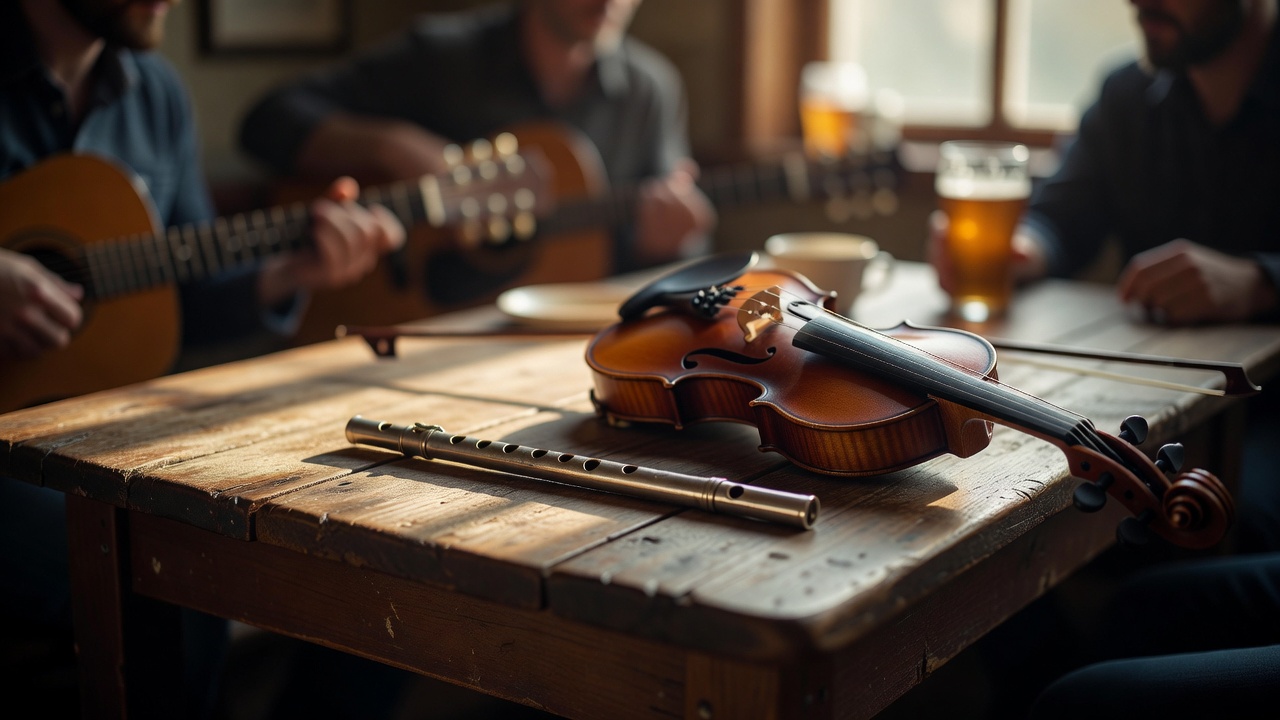
In Irish traditional music, tunes such as “The Kesh Jig” circulate through informal sessions in towns like Doolin in County Clare or in Galway’s pubs. Musicians learn by ear, then add ornaments — cuts, rolls and slides — that reflect regional styles. A tune from Sligo can feel noticeably different from the same tune in Kerry.

Some melodies do have known composers. The blind harper Turlough O’Carolan (1670–1738) wrote “Sí Bheag, Sí Mhór”, now played on every instrument imaginable. Captain Francis O’Neill, a Chicago police chief, gathered hundreds of tunes from Irish emigrants in The Music of Ireland (1903), showing how music travelled with people across the Atlantic.

In Scotland, “Loch Lomond” appeared in print in the 1840s and has many competing stories about its meaning. Treat those stories as stories; the lilting melody, with its gentle rise on the chorus, is the part you can carry home.

Central Europe: Collected in the Field

From the early 1900s, Béla Bartók and Zoltán Kodály travelled through Hungarian-speaking villages with phonographs, recording thousands of songs. Many use pentatonic scales — five notes rather than seven — which happen to be wonderfully easy to whistle because there are no awkward half-steps.

Kodály later built a music-education approach on these songs, using solfège syllables and hand signs adapted from John Curwen’s system. The principle is the one we follow here: sing (or whistle) a melody you know before you analyse it.

East Asia: Scales You Can Hear

“Sakura Sakura”, widely taught in Japan since the Meiji era, uses a pentatonic scale with a distinctly bittersweet colour. Whistle its first phrase slowly and you will hear intervals that differ from Western major-scale habits.

Korea’s “Arirang” is not one song but a large family: Jeongseon Arirang, Jindo Arirang and Miryang Arirang each have their own rhythm and mood. UNESCO inscribed Arirang for South Korea in 2012 and for North Korea in 2014 — a reminder that a single melody can carry several communities’ identities at once.

Ballads with Murky Origins

Australia’s “Waltzing Matilda” pairs Banjo Paterson’s 1895 lyrics with a tune Christina Macpherson adapted from a melody she had heard played, often identified as “Craigielee”. America’s “Shenandoah” is a 19th-century song whose origins — river song or sea shanty — are still debated.

When attribution is uncertain, we say so. Honest uncertainty is more respectful than a neat but invented origin story.

Listening for Belonging

When you hear a new tune on the road, try noticing four things before you whistle a note:

  1. Rhythm: is it a dance (jig, reel, waltz) or free-flowing like a slow air?
  2. Range: how high does it climb compared with its starting note?
  3. Ornament: are notes decorated, bent or plain?
  4. Setting: who is playing, for whom, and is joining in welcome?

Then hum, then whistle softly. The last point matters most — our customs pathway explains why.